Skincare • Barrier Health • Science Explained
Hyaluronic Acid on Broken Skin: Does It Actually Dehydrate You?
Hyaluronic acid is widely celebrated as the holy grail of hydration, capable of holding up to one thousand times its weight in water. Yet when your skin barrier is compromised, raw, or over-exfoliated, applying that same hydrating serum can leave your face feeling tighter, drier, and more irritated than before.
This frustrating paradox is not an allergic reaction, but a fundamental principle of moisture physics. When dealing with chronic tightness, anchoring your routine in a balanced simple daily skincare routine ensures your skin receives both the water it craves and the lipid seal needed to hold it in place.
The Bottom Line
Key Takeaway: Hyaluronic acid does not create moisture; it pulls water from its surroundings. On a damaged barrier or in dry air, it draws hydration from the deeper dermis up to the surface, where it rapidly evaporates through micro-fissures in the lipid matrix, worsening dehydration unless immediately sealed with an emollient cream.
In This Feature
- The Sponge Effect: How Hyaluronic Acid Attracts Water
- The Evaporation Trap: Why Damaged Skin Loses Water Faster
- Molecular Weight: When Micro-HA Triggers Stinging
- How to Safely Layer Hyaluronic Acid on Compromised Skin
- A Quick Self-Check: Healthy vs. Damaged Response
- Frequently Asked Questions
- Related Skincare Guides
The Sponge Effect: How Hyaluronic Acid Attracts Water
Hyaluronic Acid (HA) is a glycosaminoglycan naturally synthesized throughout our extracellular matrix. In cosmetic chemistry, it operates as a pure humectant—acting like a microscopic water sponge that binds ambient moisture into the surface layers of the skin.
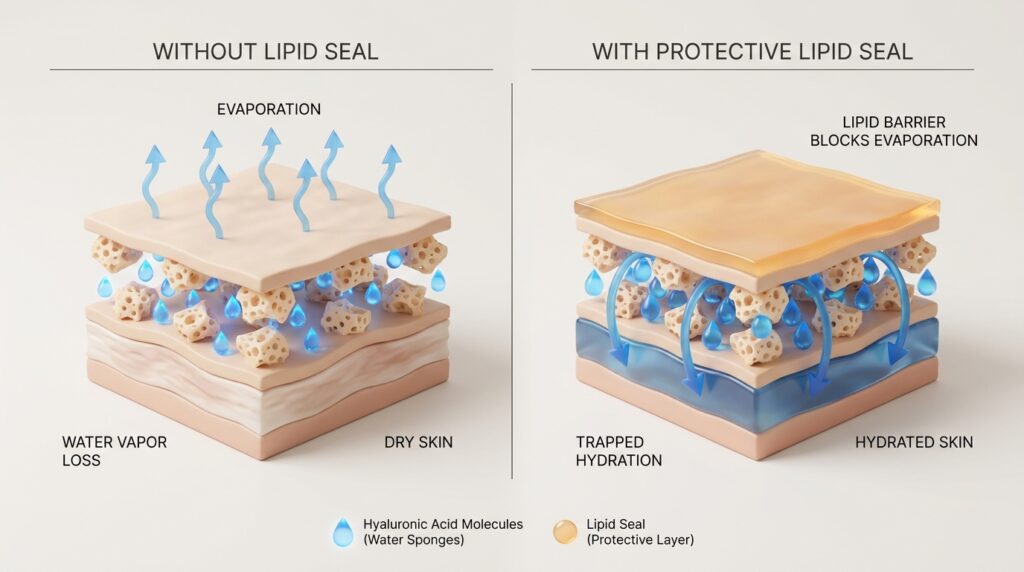
However, humectants are non-directional; they simply pull water from whichever environment has higher humidity toward an area of lower humidity. When ambient air is humid, HA draws water inward from the atmosphere. But when applied in an air-conditioned room or dry winter climate, it seeks water from the only available reservoir: the deeper layers of your own dermis.
The Evaporation Trap: Why Damaged Skin Loses Water Faster
While healthy skin relies on a resilient lipid matrix to lock in hydration[2], a compromised barrier suffers from accelerated Transepidermal Water Loss (TEWL). As explored in our foundational skin barrier guide, applying hyaluronic acid on bare skin without an emollient can draw moisture from the deeper dermis up to the surface. Without a proper lipid seal, this water rapidly evaporates into dry room air—worsening dehydration unless you pair these humectants with proper occlusive sealing techniques to create a protective physical shield.
| Skin Barrier Condition | How HA Behaves | Resulting Sensation |
|---|---|---|
| Healthy & Intact | Draws water into cells; lipid mortar seals it in | Plump, dewy, supple, comfortable |
| Compromised / Stripped | Draws water upward; water evaporates via high TEWL | Tightness, pulling, stinging, dry surface film |
Molecular Weight: When Micro-HA Triggers Stinging
Not all hyaluronic acid behaves identically. Cosmetic formulas typically blend multiple molecular weights: high-molecular-weight HA sits comfortably on the surface to form a breathable film, while low-molecular-weight (micro) HA penetrates deeper into the epidermis.
On healthy skin, micro-HA provides deeper hydration. But on an inflamed or raw barrier, fragmented low-molecular-weight molecules can penetrate too deeply, triggering cutaneous immune receptors and causing a sharp tingling or burning sensation. If your skin is actively reacting, high-molecular-weight HA or gentle glycerin is far better tolerated.
How to Safely Layer Hyaluronic Acid on Compromised Skin
You do not have to banish hyaluronic acid entirely while recovering, but your application technique must be intentional:
- 1. Never apply to dry skin: Always mist your face with plain water or a soothing thermal spray so the humectant binds surface water immediately.
- 2. Seal within 60 seconds: Without letting the serum dry down completely, immediately apply a ceramide-dominant cream over top.[3]
- 3. Add an occlusive layer in dry climates: If you live in an arid climate or work in heavy air conditioning, press a few drops of squalane oil or a thin healing balm over your cream at night.
A Quick Self-Check
Why Does Your HA Serum Feel Tight?
- If your skin feels tight 5 minutes after application: You waited too long to apply your moisturizer, allowing the serum to pull moisture outward.
- If your face stings immediately upon contact: The formula likely contains low-molecular-weight HA penetrating exposed nerves. Switch to plain glycerin or a barrier cream.
- If your face feels soft and comfortable all day: Your lipid moisturizer is sealing the humectant effectively.
Frequently Asked Questions
Should I completely stop using hyaluronic acid while repairing my barrier?
If pure HA serums cause stinging or tightness, it is best to set them aside for one to two weeks. Focus instead on a rich moisturizer that already contains balanced humectants and ceramides, which delivers hydration alongside the lipids required to trap it.
Is glycerin a gentler alternative to hyaluronic acid?
Yes. Glycerin is a smaller, bio-compatible humectant that works harmoniously with aquaporin water channels in skin cells. It rarely triggers stinging on compromised skin and provides steady, non-reactive surface hydration.
Medical & Wellness Disclaimer: The information provided on Hinubix is for general educational and informational purposes only and does not constitute medical, psychological, or dermatological advice, diagnosis, or treatment. If you are navigating persistent sleep issues, chronic stress, or unexplained health or skin concerns, please consult a qualified healthcare professional or board-certified specialist for personalized guidance.”
A Note From Nubix ☁️
“Whenever the world feels a little too loud, close your eyes and take a quiet moment. Nubix is cheering for you softly!”
Medical References
This article was developed and fact-checked based on peer-reviewed dermatological research from the following clinical sources:
- Dermato-Endocrinology. Papakonstantinou, E., Roth, M., & Karakiulakis, G. (2012). “Hyaluronic acid: A key molecule in skin aging.” Available at PubMed Central ↩
- The Journal of Clinical and Aesthetic Dermatology. Del Rosso, J. Q., & Levin, J. (2011). “The clinical relevance of maintaining the functional integrity of the stratum corneum in both healthy and disease-affected skin.” Available at PubMed Central ↩
- Dermatologic Therapy. Rawlings, A. V., & Harding, C. R. (2004). “Moisturization and skin barrier function.” Available at PubMed ↩