Skincare • Sun Protection • Ingredient Guide
How to Choose a Pure Mineral Sunscreen for Compromised Skin
Affiliate Disclosure: This post contains affiliate links. If you make a purchase through these links, we may earn a small commission at no additional cost to you. As an Amazon Associate, we earn from qualifying purchases. We only recommend products we believe may provide value to our readers. Read our full Affiliate Disclosure here.
When your skin barrier is compromised, smoothing on sunscreen can feel like an impossible task. Chemical filters that previously felt weightless suddenly sting on contact, causing warmth, redness, and water-like burning across your cheekbones.
Yet skipping sun protection while your barrier is raw leaves healing tissue vulnerable to ultraviolet degradation. Finding a gentle, non-irritating formula is the cornerstone of any simple daily skincare routine, shielding delicate skin cells while natural lipid repair takes place.
The Bottom Line
Key Takeaway: Pure mineral sunscreens formulated with Zinc Oxide sit passively on the skin surface to reflect UV rays without generating chemical heat or penetrating micro-fissures. Look for fragrance-free, hydrating mineral formulas that soothe redness while providing broad-spectrum SPF 30 to SPF 50+ protection.
In This Feature
- Mineral vs. Chemical: Why Broken Skin Rejects Chemical Filters
- The Zinc Oxide Advantage: Passive Defense and Soothing Care
- What to Look for in a Sensitive Skin Mineral Sunscreen
- The Editor’s Choice: Two Calming Mineral Formulations
- A Quick Self-Check: Application and Removal Tips
- Frequently Asked Questions
- Related Skincare Guides
Mineral vs. Chemical: Why Broken Skin Rejects Chemical Filters
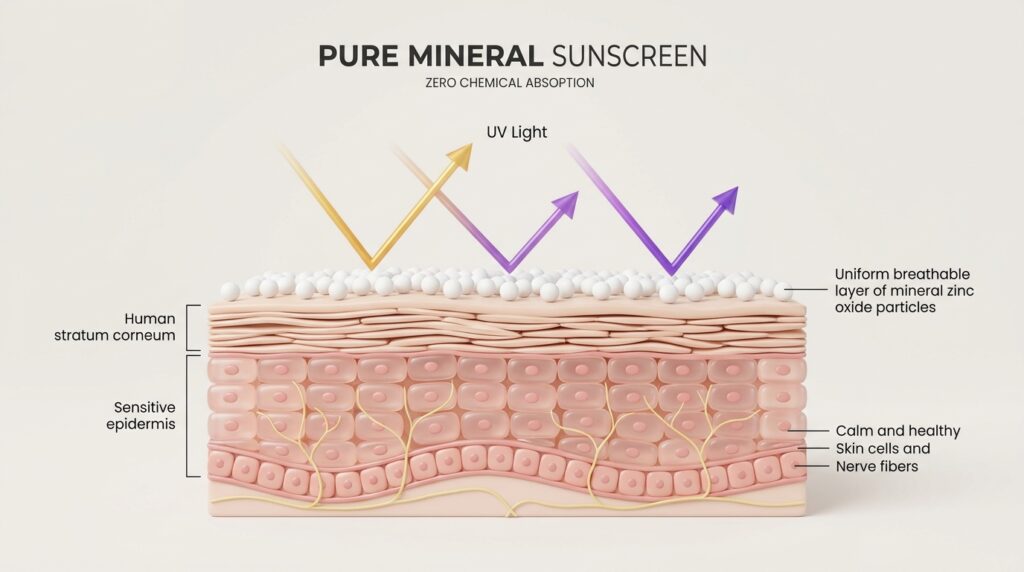
To understand why your usual sunscreen suddenly stings, look to how different UV filters interact with the epidermis.[2] Chemical filters (such as avobenzone, octinoxate, and homosalate) absorb UV rays by converting light into thermal heat, releasing warmth across the skin surface.
On healthy skin, this thermal conversion happens unnoticed. But on a compromised stratum corneum where intercellular lipids are fractured, chemical molecules penetrate too deeply, directly irritating exposed nerve endings and triggering vasodilation, redness, and stinging.
| Sunscreen Feature | Chemical Sunscreen | Pure Mineral Sunscreen |
|---|---|---|
| Active UV Filters | Avobenzone, Octisalate, Octocrylene | Zinc Oxide and Titanium Dioxide |
| Protection Mechanism | Absorbs UV rays and converts them into heat | Reflects, scatters, and deflects UV rays passively |
| Reaction on Raw Skin | Frequently triggers warmth, redness, and stinging | Sits comfortably on the surface with zero chemical heat |
| Additional Benefits | Invisible finish, easy absorption | Natural anti-inflammatory and skin-protecting qualities |
The Zinc Oxide Advantage: Passive Defense and Soothing Care
Zinc Oxide is unique among sunscreen filters. Beyond providing broad-spectrum coverage against both UVA and UVB rays, pharmaceutical-grade zinc oxide has been used in clinical dermatology for over a century for its soothing, skin-protective benefits.[2]
Because zinc oxide particles sit on top of the stratum corneum without penetrating broken tissue, they create a physical barrier that calms inflammation while deflecting sunlight. Research in Photodermatology, Photoimmunology & Photomedicine confirms that consistent daily mineral photoprotection prevents UV-induced oxidative breakdown in the lipid matrix.
What to Look for in a Sensitive Skin Mineral Sunscreen
Not all mineral sunscreens feel the same. To avoid the chalky, drying finish historically associated with physical blockers, check for these four formulation details:
- 1. Fragrance-free and essential-oil-free: Volatile aromatic oils can cause contact dermatitis on compromised skin. Prioritize fragrance-free formulas.
- 2. Hydrating and emollient base: Look for formulas enriched with hyaluronic acid, glycerin, or ceramides so the mineral powder does not draw moisture out of dry patches.
- 3. Light tint for blue light defense: Iron oxides used in tinted mineral sunscreens help neutralize white cast while shielding against visible blue light.
- 4. Non-drying texture: Choose silky fluid lotions or light cream bases that spread smoothly without requiring harsh rubbing.
The Editor’s Choice: Two Calming Mineral Formulations
Here are two gentle, dermatologist-trusted mineral sunscreens that provide reliable broad-spectrum protection without stinging reactive skin:
OUR EDIT
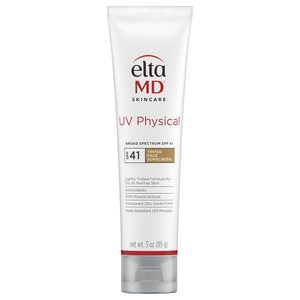
EltaMD UV Physical Broad-Spectrum SPF 41
An oil-free, lightly tinted mineral sunscreen utilizing zinc oxide (9.0%) and titanium dioxide (7.0%). It provides water-resistant protection with antioxidant support, calming post-procedure and sensitive complexions seamlessly.
OUR EDIT
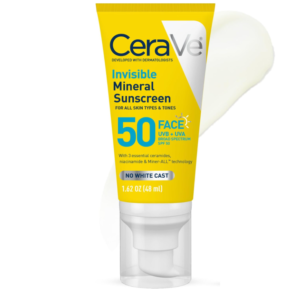
CeraVe Invisible Mineral Sunscreen SPF 50
An oil-free mineral sunscreen powered by zinc oxide, titanium dioxide, ceramides, and soothing niacinamide. It glides on smoothly to protect and repair sensitive skin without heavy white cast or pore-clogging grease.
A Quick Self-Check
Application and Removal Tips
- Warm between fingers before applying: Spreading mineral sunscreen in sections rather than rubbing vigorously reduces mechanical friction on raw skin.
- Allow moisturizer to absorb first: Giving your morning cream 60 seconds to set prevents mineral zinc from pilling or dragging.
- Remove gently with a cleansing lotion: Avoid harsh makeup-remover wipes; a mild cleansing milk easily lifts mineral filters without stripping lipids.[3]
Frequently Asked Questions
Is mineral sunscreen safe to use on raw or peeling skin?
Yes. Pure zinc oxide is inert and does not absorb into living epidermal tissue. It is routinely recommended by dermatologists following chemical peels and laser treatments because it shields against UV rays without triggering chemical burning.
Does zinc oxide cause pore congestion on acne-prone skin?
No. Zinc oxide is non-comedogenic and has mild natural antimicrobial properties. However, water-resistant sunscreen bases must be thoroughly cleansed off each evening using a gentle wash to prevent buildup in the pores.
Medical & Wellness Disclaimer: The information provided on Hinubix is for general educational and informational purposes only and does not constitute medical, psychological, or dermatological advice, diagnosis, or treatment. If you are navigating persistent sleep issues, chronic stress, or unexplained health or skin concerns, please consult a qualified healthcare professional or board-certified specialist for personalized guidance.”
A Note From Nubix ☁️
“Let go of what you couldn’t finish today. Tomorrow is a brand new morning full of soft light and sweet possibilities.”
Medical References
This article was developed and fact-checked based on peer-reviewed dermatological research from the following clinical sources:
- Photodermatology, Photoimmunology & Photomedicine. Krutmann, J., et al. (2017). “Daily photoprotection to prevent photoaging.” Available at PubMed ↩
- Nanotechnology, Science and Applications. Smijs, T. G., & Pavel, S. (2011). “Titanium dioxide and zinc oxide nanoparticles in sunscreens: focus on their safety and effectiveness.” Available at PubMed Central ↩
- The Journal of Clinical and Aesthetic Dermatology. Del Rosso, J. Q., & Levin, J. (2011). “The clinical relevance of maintaining the functional integrity of the stratum corneum in both healthy and disease-affected skin.” Available at PubMed Central ↩