Skincare • Barrier Health • Recovery Guide
5 Hidden Signs Your Skin Barrier Is Damaged (And Why It Keeps Burning)
We tend to think of skin barrier damage as a sudden, dramatic crisis—a bright red face, raw peeling, and a scream of pain when a moisturizer touches your cheek. While that acute breakdown certainly happens, more often, a compromised barrier is a silent, creeping leak.
It develops quietly over weeks of seemingly harmless habits, presenting as subtle shifts in texture and behavior that most women misdiagnose for months.
At Hinubix, we believe recognizing these quiet signals is the first step toward lasting comfort. Once your barrier begins to recover, transitioning into a balanced simple daily skincare routine will prevent chronic flare-ups and give your skin room to maintain its natural resilience.
The Bottom Line
Key Takeaway: A compromised skin barrier often presents as stinging from mild products, tight skin with surface oiliness, rough texture that resists hydration, and chronic flushing. The persistent burning occurs because depleted intercellular lipids expose sensory nerve endings in the upper epidermis directly to air and product emulsifiers.
In This Feature
Why Your Skin Keeps Burning: The Exposed Nerve Phenomenon
In healthy skin, the stratum corneum serves as an insulating biological jacket. Flattened corneocytes (skin cells) are tightly glued together by a continuous mortar of Ceramides, Cholesterol, and Free Fatty Acids, shielding microscopic free nerve endings that sit just beneath the surface.[2]
When this lipid seal breaks down from over-exfoliation or harsh cleansers, microscopic cracks form across the stratum corneum. Suddenly, sensory C-fibers become directly exposed to ambient air, temperature changes, and product ingredients. Understanding why water stings raw skin helps explain why even tap water can trigger sharp neurogenic burning on damaged skin.
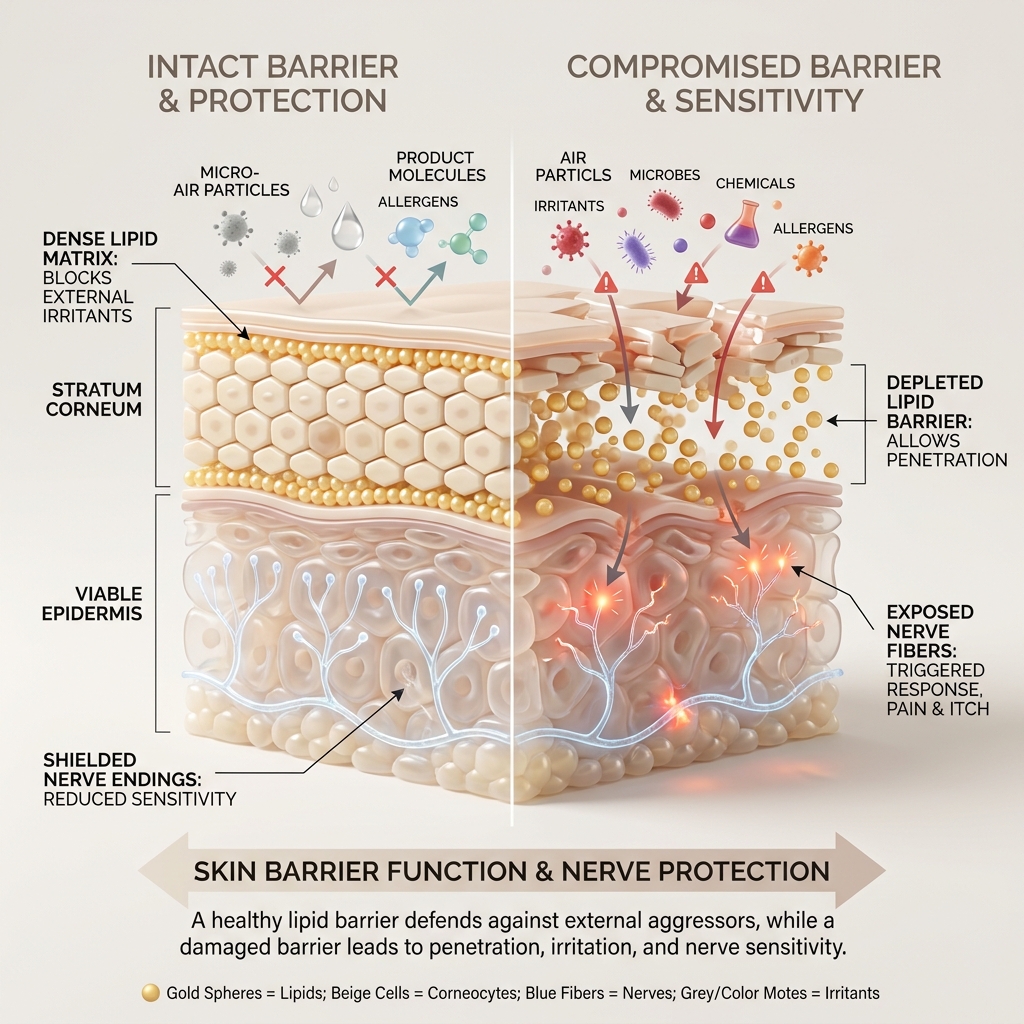
5 Hidden Signs Your Skin Barrier Is Damaged
Many women assume barrier damage only happens after aggressive chemical peels. In reality, everyday routines often cause quiet structural wear. If you recognize two or more of these subtle signs, your barrier is asking for immediate relief:
1. Your Gentle Products Suddenly Burn or Tingle
A basic hydrating toner or plain moisturizer should feel soothing upon application. If formulas that previously caused zero irritation suddenly produce a warm, stinging sensation around your cheekbones or nostrils, your acid mantle and lipid mortar have broken down, allowing product vehicles to reach exposed nerve endings.
2. Your Skin Feels Tight Yet Looks Reflective and Shiny
This is one of the most frequently misunderstood signals. When the stratum corneum is stripped of natural moisture, the outermost cells shrink and pull taut like plastic wrap, creating a reflective, glass-like sheen. People often mistake this surface shine for excess sebum and use drying cleansers, worsening the underlying dehydration.
3. Rough, Sandpapery Texture That Won’t Exfoliate Away
Natural desquamation—the invisible shedding of dead skin cells—relies on moisture-dependent enzymes called corneodesmosomes.[3] When your barrier lacks hydration and lipids, these enzymes shut down, causing dead cells to clump into stubborn, rough patches. Scrubbing these patches with physical exfoliants tears the new tissue underneath.
4. Sudden Intolerance to Sunscreen and Makeup
If your daily sunscreen pills into little white rolls or your foundation suddenly clings to dry patches while breaking apart by midday, your skin surface is unevenly dehydrated. Chemical sunscreen filters can also trigger heat sensations on raw skin as they convert UV rays into thermal energy.
5. Unexplained Redness and Chronic Flushing
When the physical shield is compromised, environmental allergens and airborne pollution easily penetrate into living epidermal tissue. This triggers localized immune responses, releasing pro-inflammatory cytokines and dilating surface capillaries, leaving your cheeks persistently flushed long after washing.
A Quick Self-Check
Healthy Barrier vs. Compromised Barrier
- Healthy Barrier: Skincare absorbs comfortably without tingling; skin feels flexible after cleansing; makeup applies evenly without flaking.
- Compromised Barrier: Basic moisturizers and water cause stinging; face feels pulled tight two hours after washing; surface looks shiny while feeling dry underneath.
- Immediate Action: If your skin experiences persistent stinging, intense burning, cracking, or severe irritation at any point, discontinue all active products immediately and consult a board-certified dermatologist.
Immediate First Aid: What to Do Today
When your skin is actively burning, trying to power through your normal routine will only extend recovery time. Dermatologists recommend a strict, three-part reset to calm inflammation quickly:
- 1. Strip down to water and plain cream: Pause all vitamin C, AHAs, BHAs, and retinoids. Cleanse with a mild lotion wash or lukewarm water only.
- 2. Seal with physiological ceramides: Apply a rich barrier cream containing ceramides, cholesterol, and fatty acids over slightly damp skin to plug micro-cracks.[2]
- 3. Switch to physical mineral SPF: Protect healing skin with a pure zinc oxide sunscreen that shields UV rays without generating chemical heat on raw tissue.
Frequently Asked Questions
Can a damaged skin barrier cause acne breakouts?
Yes. When your barrier breaks down, surface moisture evaporates rapidly, prompting your sebaceous glands to overproduce oil to compensate. Combined with microscopic skin cracking and bacterial entry, this often triggers sudden clusters of small, inflamed blemishes.
How long does it take for the burning sensation to stop?
Once all active acids, retinoids, and foaming washes are removed, the acute stinging and burning sensation typically begins to subside within three to five days. Full structural recovery of the stratum corneum lipid matrix takes between two and four weeks.
Should I avoid washing my face with tap water if it stings?
If municipal tap water with high mineral content causes severe stinging, use lukewarm distilled water or a soothing thermal spring water spray for two to three days. Cleanse with a wipe-off gentle lotion cleanser to avoid friction until the barrier calms.
Medical & Wellness Disclaimer: The information provided on Hinubix is for general educational and informational purposes only and does not constitute medical, psychological, or dermatological advice, diagnosis, or treatment. If you are navigating persistent sleep issues, chronic stress, or unexplained health or skin concerns, please consult a qualified healthcare professional or board-certified specialist for personalized guidance.”
A Note From Nubix ☁️
“rest is not a reward you have to earn, but a sweet pause you deserve every single day.”
Medical References
This article was developed and fact-checked based on peer-reviewed dermatological research from the following clinical sources:
- The Journal of Clinical and Aesthetic Dermatology. Del Rosso, J. Q., & Levin, J. (2011). “The clinical relevance of maintaining the functional integrity of the stratum corneum in both healthy and disease-affected skin.” Available at PubMed Central ↩
- Journal of Investigative Dermatology. Elias, P. M. (1983). “Epidermal lipids, barrier function, and desquamation.” Available at PubMed ↩
- Dermatologic Therapy. Rawlings, A. V., & Harding, C. R. (2004). “Moisturization and skin barrier function.” Available at PubMed ↩