Skincare • Barrier Health • Science Explained
Why Does Your Face Sting from Plain Water? The Science Explained
Leaning over the bathroom sink, you splash lukewarm water across your face, expecting relief. Instead, you are met with an unexpected, sharp stinging sensation that leaves your cheeks red, hot, and raw to the touch.
Water is the most natural substance on earth, so feeling it burn can be alarming. At Hinubix, we believe this stinging is the most honest message your skin can send: an urgent signal that your protective lipid barrier has broken down. Pausing all active serums, scaling back to a simple daily skincare routine, and following a step-by-step barrier recovery protocol gives your stratum corneum the quiet environment it needs to seal those microscopic fissures.
The Bottom Line
Key Takeaway: Plain water stings when the stratum corneum’s lipid matrix is cracked, directly exposing sensory C-fibers to osmotic shock, hard water minerals, and pH shifts. The solution is not to stop cleansing entirely, but to use lukewarm water, avoid foaming cleansers, and immediately seal raw areas with bio-identical ceramides.
In This Feature
The Biological Paradox: Why Neutral Water Burns
In an intact stratum corneum, skin cells are sealed by an organized lipid matrix of Ceramides, Cholesterol, and Fatty Acids.[2] This lipid seal acts as an insulating shield, preventing water on the outside from making direct contact with living cells and delicate nerve fibers beneath.
When this lipid shield is stripped away by over-exfoliation, harsh foaming surfactants, or dry indoor heating, microscopic channels open across the skin surface. When water flows over these cracks, it touches exposed intraepidermal sensory nerves, triggering an instant neurogenic pain reflex.
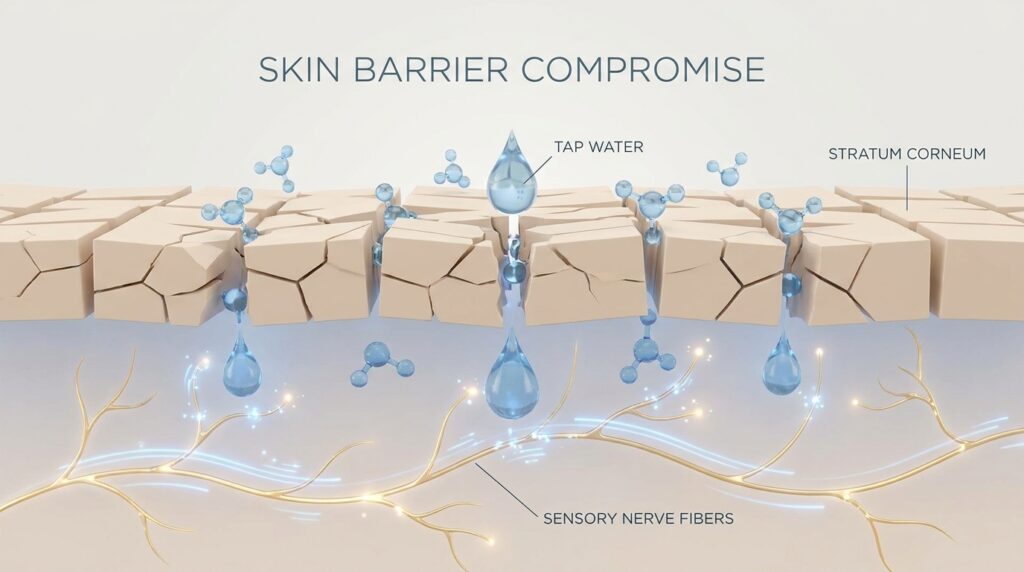
The 3 Scientific Triggers Behind Water Sensitivity
Board-certified dermatologists note that when water stings, three distinct biochemical factors are interacting simultaneously on the damaged skin surface:
- 1. Osmotic Pressure Shift: Living skin cells maintain an internal electrolyte and solute concentration. When pure water enters raw, cracked tissue, it rushes into the cells via osmosis, causing them to swell rapidly and triggering nerve firing.
- 2. pH Shock to the Acid Mantle: Healthy skin maintains a protective acidic pH between 4.7 and 5.5. Municipal tap water is generally neutral to slightly alkaline (pH 7.0 to 8.5), creating a sudden pH shock that inflames compromised acid mantle enzymes.
- 3. Hard Water Minerals & Chlorine: Tap water contains dissolved minerals (calcium, magnesium) and disinfectant chlorine. While harmless to healthy skin, these dissolved ions act as direct chemical irritants when they penetrate micro-fissures.
| Water Factor | Normal Skin Reaction | Compromised Skin Reaction |
|---|---|---|
| Osmotic Balance | Blocked by lipid mortar | Rapid cellular swelling, sharp stinging |
| Alkaline pH (7.5–8.5) | Acid mantle self-corrects in 30 mins | Enzyme disruption, immediate redness |
| Chlorine & Minerals | Rinsed away cleanly | Direct chemical irritation on raw nerve fibers |
How to Safely Wash Your Face When It Stings
When water causes active pain, you do not need to stop cleansing completely, but you must alter your washing technique to minimize friction and osmotic shock:
- Use strictly lukewarm water: Hot water dissolves what little surface sebum remains, while freezing water causes sudden vascular constriction. Aim for neutral, body-temperature water.
- Consider thermal water spray for 48 hours: If municipal tap water is particularly hard or chlorinated, mist your face with a sterile, low-mineral thermal spring water spray to cleanse without stinging.
- Swap to a wipe-off cleansing milk: Fragrance-free lotion cleansers can be gently applied with clean fingertips and blotted off with a damp cotton pad, bypassing the need for heavy splashing.
- Apply lipid cream within 60 seconds: Before surface water has a chance to evaporate and draw internal moisture outward, seal the skin with a rich ceramide-dominant moisturizer.[3]
A Quick Self-Check
Assessing Barrier Damage Severity
- Mild (Stings for 10–15 seconds then settles): Your acid mantle is irritated. Pause active acids and retinoids for 7 days; use a ceramide cream twice daily.
- Moderate (Stings continuously, visible redness and tight sheen): Intercellular lipids are depleted. Pause all exfoliants for 2 to 3 weeks; add a soothing balm over raw areas.
- Severe (Water feels like needles, oozing or cracked skin): Immediate barrier collapse. Stick strictly to plain water, a basic healing ointment, and consult a dermatologist if redness spreads.
If your skin experiences persistent stinging, intense burning, cracking, or severe irritation at any point, discontinue all active products immediately and consult a board-certified dermatologist.
Frequently Asked Questions
Is it possible to be allergic to plain water?
True water allergy (aquagenic urticaria) is exceptionally rare and involves physical hives. In 99% of cases, water stinging is not an allergy, but a physical consequence of exposed sensory nerves beneath a cracked stratum corneum.
How many days until water stops stinging?
Once all active exfoliants, retinoids, and foaming cleansers are removed, the acute burning sensation typically begins to calm down within 48 to 72 hours as surface lipids begin to re-align.
Should I completely avoid washing my face while healing?
You do not need to avoid hygiene entirely. In the morning, splashing gently with lukewarm water is sufficient. In the evening, use a soothing lotion cleanser wiped off with a damp cotton pad to remove daily grime without mechanical friction.
Medical & Wellness Disclaimer: The information provided on Hinubix is for general educational and informational purposes only and does not constitute medical, psychological, or dermatological advice, diagnosis, or treatment. If you are navigating persistent sleep issues, chronic stress, or unexplained health or skin concerns, please consult a qualified healthcare professional or board-certified specialist for personalized guidance.”
A Note From Nubix ☁️
“Put on your favorite cozy socks, light a gentle candle, and let your heart rest. You are doing so much better than you think.”
Medical References
This article was developed and fact-checked based on peer-reviewed dermatological research from the following clinical sources:
- The Journal of Clinical and Aesthetic Dermatology. Del Rosso, J. Q., & Levin, J. (2011). “The clinical relevance of maintaining the functional integrity of the stratum corneum in both healthy and disease-affected skin.” Available at PubMed Central ↩
- Journal of Investigative Dermatology. Elias, P. M. (1983). “Epidermal lipids, barrier function, and desquamation.” Available at PubMed ↩
- Dermatologic Therapy. Rawlings, A. V., & Harding, C. R. (2004). “Moisturization and skin barrier function.” Available at PubMed ↩